 By Admin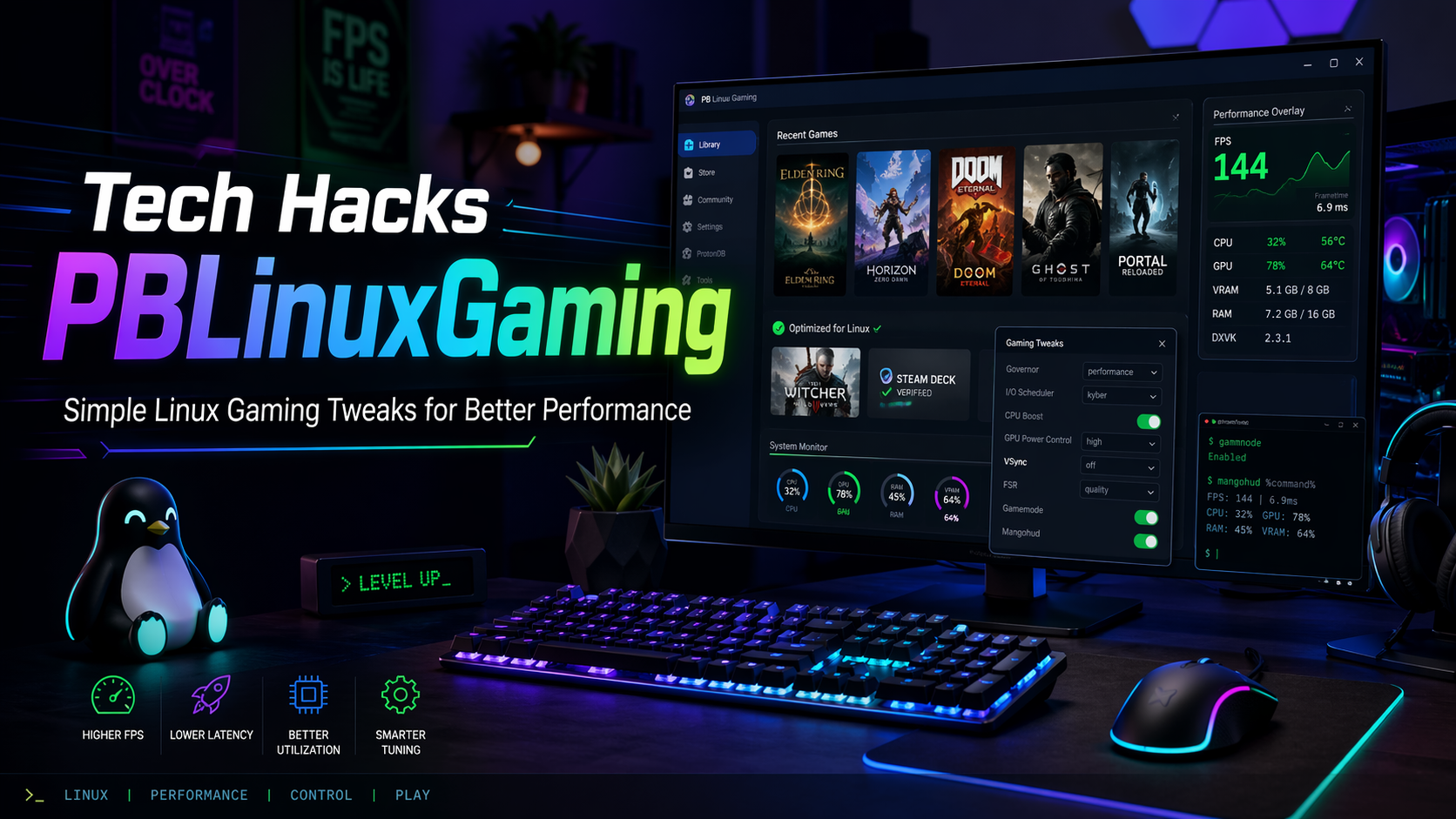
If you search for “tech hacks pblinuxgaming,” what you’ll usually find is not one official app or one magic tool. It’s more like a label for Linux gaming tweaks, guides, and performance tips shared around the PB Linux Gaming site and similar content. PB Linux Gaming itself describes these hacks as changes to tools and settings that can improve graphics, customization, stability, and overall gameplay.
And honestly, that makes sense.
Linux gaming has gotten a lot better, but it still rewards people who like to tweak things just a little. Not too much. Just enough to make games launch cleaner, run smoother, and feel less frustrating.
What “tech hacks pblinuxgaming” really means
In plain English, this keyword is about smart Linux gaming adjustments. Not cheating. Not shady patches. Just practical things like using the right compatibility layer, checking performance overlays, choosing a better launcher, or fixing graphics settings so your game behaves the way it should. PB Linux Gaming frames these hacks as settings and environment changes that improve efficiency, responsiveness, and stability.
That’s the real idea behind it.
You’re not rebuilding Linux from scratch. You’re just learning which switches matter.
The core tools behind these tech hacks
A lot of the best Linux gaming advice keeps coming back to the same small set of tools. Here’s the short version:
| Tool | What it does | Why people use it |
|---|---|---|
| Proton | Runs many Windows-only Steam games on Linux through Steam Play. | It’s the first thing most Linux gamers rely on. |
| GameMode | Temporarily applies system optimizations to the OS or game process while you play. | Helps reduce power-saving bottlenecks. |
| MangoHud | Shows FPS, frame times, temperatures, and CPU/GPU usage in-game. | Lets you see whether your tweaks actually worked. |
| DXVK / vkBasalt | DXVK translates older Direct3D graphics calls to Vulkan, while vkBasalt adds post-processing effects like sharpening and anti-aliasing. | Good for compatibility first, visuals second. |
That table looks simple. But these four tools do a lot of heavy lifting on Linux.
Start with Proton, because it changes everything
For most people, Proton is where Linux gaming really starts. Valve describes Proton as a tool used with the Steam client that allows Windows-only games to run on Linux, and it says most users should use the version provided through Steam itself.
So the first “hack” is not really a hack at all:
- Turn on Steam Play for supported and unsupported titles when needed. Proton is built exactly for that use case.
- If one Proton version acts weird, test another one. Proton releases keep improving game support and fixes over time.
- Before buying a game, check compatibility reports. ProtonDB exists specifically for crowdsourced Linux and Steam Deck compatibility reports.
That one habit alone saves time. A lot of time.
Use GameMode and MangoHud together
This is one of those small combos that feels almost too obvious once you try it.
GameMode is designed to apply temporary optimizations while a game is running. It started as a fix for CPU governor issues, but it now supports a wider range of optimization features.
MangoHud, on the other hand, gives you a live performance overlay with FPS, temperatures, frame times, and CPU/GPU load.
So here’s the practical move:
- Run the game once normally and watch the numbers in MangoHud.
- Then enable GameMode and compare the results.
- If FPS barely changes but frame times get smoother, that still counts. Smoothness matters more than bragging rights.
That’s the kind of thing “tech hacks pblinuxgaming” should mean—small, testable improvements. Not random guesswork.
Don’t ignore your graphics stack
A lot of Linux gaming performance depends on the graphics stack under the hood. The Mesa project implements major graphics APIs including OpenGL ES, Vulkan, and EGL, and it supports hardware acceleration across many GPU environments. NVIDIA also provides official Linux Vulkan drivers through its driver releases.
So yes, keeping graphics drivers and Vulkan support in good shape matters.
But here’s the calmer version of that advice:
- On AMD and Intel systems, pay attention to Mesa updates because that stack handles major graphics APIs used by games.
- On NVIDIA systems, make sure you’re using an appropriate official Linux driver with Vulkan support.
- If a game behaves oddly, driver age can be part of the story. That’s a reasonable inference from how central Mesa and Vulkan driver support are to Linux graphics.
Not glamorous, I know. Still important.
Lutris and Heroic make life easier
Sometimes the best hack is not technical at all. It’s organizational.
Lutris says it makes it easy to run old and new games on Linux and can connect to libraries from Steam, Epic Games Store, GOG, and Humble Bundle from one place. Heroic is a free and open-source launcher for Epic, GOG, and Amazon Prime Games on Linux, Windows, and macOS, including Steam Deck support.
That means:
- Use Steam + Proton for the cleanest mainstream setup.
- Use Lutris if your library is scattered across services or older installers.
- Use Heroic if you mostly care about Epic or GOG on Linux.
And yes, having fewer launch headaches absolutely counts as a tech hack.
A few visual tweaks are fine… just don’t overdo them
DXVK and vkBasalt are where a lot of Linux gaming enthusiasts start having fun.
DXVK translates Direct3D 8, 9, 10, and 11 to Vulkan for Linux via Wine. vkBasalt adds Vulkan post-processing effects like sharpening, anti-aliasing options, and LUT-based color tweaks.
Used carefully, they can help. Used badly, they can create extra noise.
A good rule:
- Use DXVK for compatibility and performance paths where it makes sense.
- Use vkBasalt lightly for sharpening or cleaner visuals, not as a way to bury performance problems under filters.
Because sometimes a sharper image feels nice… until your frame pacing goes weird.
Check compatibility before blaming Linux
This part matters more than people admit.
Valve’s Steam Deck Verified system sorts games into Verified, Playable, Unsupported, and Unknown. Valve also notes that if a game runs through Proton, its middleware must be supported too, and that includes anti-cheat support.
So if a game refuses to run, it doesn’t always mean your distro is broken.
It might mean:
- the title is still Unsupported on Valve’s compatibility review,
- the launcher needs manual tweaking, which falls into Playable,
- or anti-cheat and middleware support are still getting in the way.
That little mindset shift helps. It keeps you from wasting hours fixing the wrong thing.
Final thoughts
So, what are tech hacks pblinuxgaming really about?
They’re about using the right Linux gaming tools in a smart order. Start with Proton. Measure results with MangoHud. Add GameMode when needed. Keep your graphics stack healthy. Use Lutris or Heroic to simplify libraries. And always check compatibility before assuming the problem is your whole system. PB Linux Gaming presents the idea as making thoughtful tool and settings changes to improve the gaming experience, and that’s the most useful way to understand the phrase.
That’s the real hack.
Not tricking Linux. Just learning how to work with it.